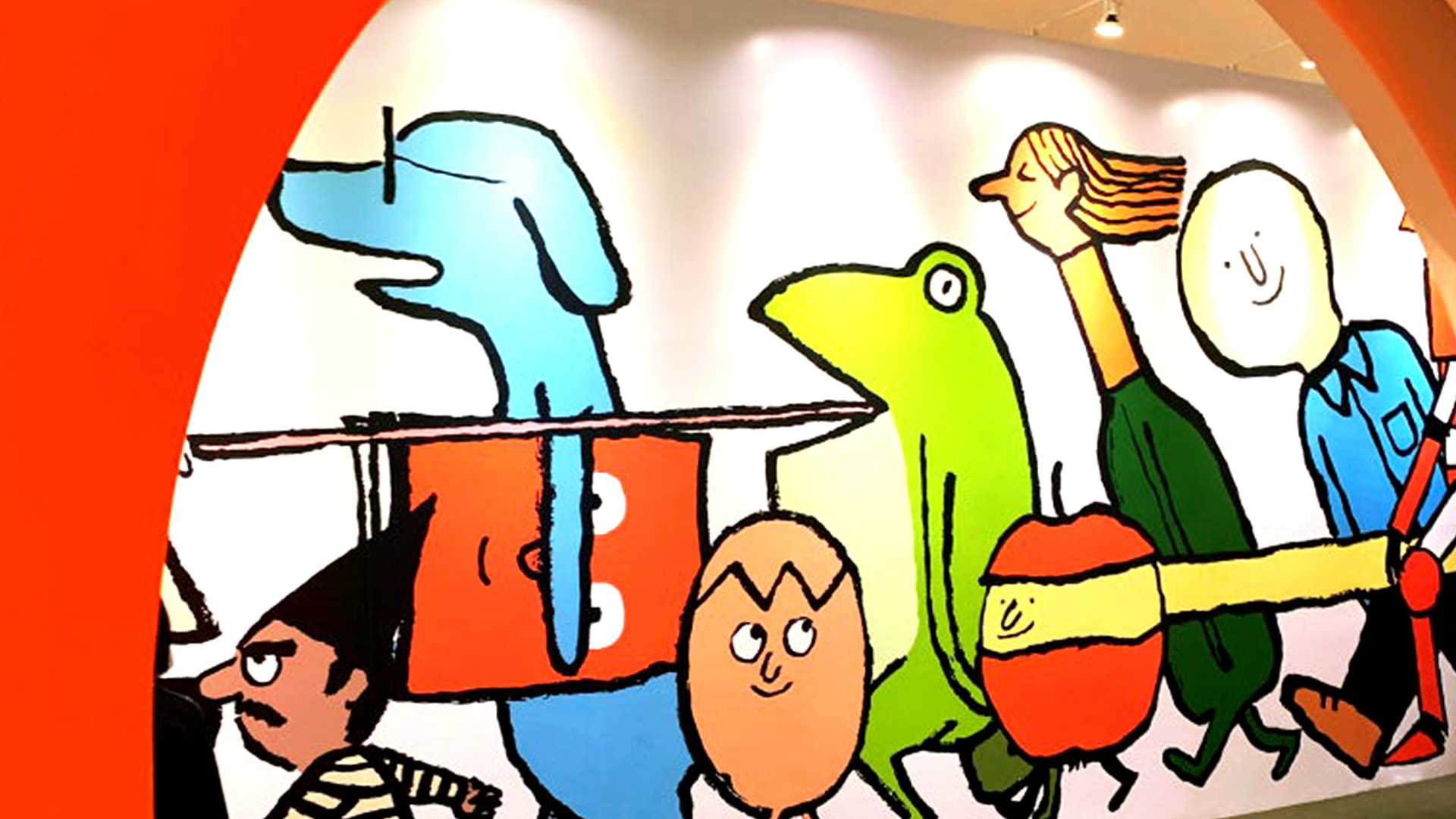

Jean Jullien
French Illustrator
Hello, this is Shine from ArtyShine Studio.
Today I’d like to introduce Jean Jullien, a French artist who has been consistently loved by the Korean public and is well known for his many collaborations and merchandise projects.
Before we begin, I want to mention that this post is based on the questions I had about him. I researched through the internet and books, and the writing also includes some of my personal thoughts and opinions.


Who is Jean Jullien?
Jean Jullien is a French graphic artist born in 1983. Like many children, he spent his early years constantly drawing. His father loved music and comic books, while his mother was both an architect and a curator. She often introduced him to architecture, design, and the works of various artists. Looking back, it seems that this environment played a big role in shaping his passion and the path he eventually took as an artist.
Originally, Jullien wanted to become an animator. After being rejected by several schools, he enrolled in a graphic design program in a small town. Later, he moved to London and was accepted into Central Saint Martins. He went on to complete his studies at the Royal College of Art as well.
During his time in London, he met people from all over the world and experimented with many different mediums — photography, textiles, printmaking, drawing, installation, and more. From 2007, he began working more seriously as a professional. Since then, he has always balanced commercial projects with his own personal work.
How Did He Build His Own Style?
Artists He Admires
Jean Jullien has said that he deeply respects Paul Rand and Saul Bass. He is also very fond of French artists such as Raymond Savignac, a poster designer from the 1960s, the cartoonist Tomi Ungerer, and Jean-Jacques Sempé.
What he loves about their work is the simple and humorous way they capture life. He is also drawn to the way they approached their practice.
According to Jullien, Jean-Jacques Sempé is an artist who looks at people and the way they live with a soft, gentle gaze.
In contrast, Saul Bass and Paul Rand took practical ideas and applied them commercially in a highly creative way. Tomi Ungerer’s work is especially diverse — from children’s books to anti-war posters, advertisements, and exhibitions. Jullien finds this range of expression particularly interesting.
At this point, let’s take a look at some of their works.


Looking at their works, it becomes clear why Jean Jullien chose them as artists he admires, and how much influence they had on his own visual world.
The works of the poster artists are impactful and iconic. They catch the eye immediately and leave a strong impression, often using just two or three contrasting colors that make the images stand out even more.
In a similar way, Jean Jullien’s own work also leaves a lasting impression through bold colors and clever ideas that grab attention at first glance.
While researching Jullien, I also looked into many of Tomi Ungerer’s comic works. They are full of humor and inventive ideas, creating a sense of playful joy. It seems that the comics Jullien encountered during his childhood left a lasting influence on him.
From my personal perspective, the influence Jean Jullien received from these artists can be summarized in three things:
1.Art Practice , 2.Sense of Humor , 3.The beauty found in everyday life (almost like keeping a visual journal). These elements seem to run through both their works and his own.
About Jean Jullien’s Work
Before talking more about his work, let’s take a look at some of his pieces.


These Image source from : CentralWorld/CPN
Looking at Jean Jullien’s work, you can often find inventive ideas and a strong sense of humor. He has said that while he doesn’t always use humor, it is sometimes a tool he uses to express his drawings.
When creating a piece, he often starts by asking himself, “What do I want to say?” Then he adds a layer of humor so that the message can reach people in a direct and efficient way.
While his work is often humorous, I also feel that many of his pieces carry a quiet commentary on today’s society. They can be enjoyed simply as fun and playful images, but if you look a little deeper, there is often a more thoughtful message underneath.


These Image source from : CentralWorld/CPN
These days, it is difficult to live without a smartphone or digital devices. During the pandemic, when people could not go outside, Jullien drew scenes of people making a toast online. On the subway, almost no one is without a phone in their hands. People take photos of their food to post on social media. These are scenes we see all around us in daily life.
Jean Jullien’s humorous works seem to offer a quiet moment to pause. Through playful images, they allow us to look back at ourselves — at the things we already know but often choose to ignore.


Today, Jean Jullien continues to work with numerous clients, collaborate across different fields, and hold exhibitions around the world, establishing himself as a truly global artist. He has drawn attention from major publications such as The New York Times, National Geographic, and The New Yorker. In Korea as well, he has gained wide public love, leading to various collaboration products and even café projects inspired by his work.
I believe one of the reasons he is so well loved is that his work delivers messages that are both catchy and impactful, while also carrying a sense of humor. No matter how many times you look at his pieces, they still bring a feeling of lightness and joy.
The Exhibition I Visited in Korea
Jean Jullien – Then, There
Photography © ArtyShine. All rights reserved.


This exhibition was Jean Jullien’s first large-scale retrospective, and it was held for the first time in the world in Seoul in 2022.
It was a great opportunity to experience the richness and variety of his artistic world.


Jean Jullien’s 100 Sketchbooks


On the walls, there were sketches that Jean Jullien painted live during the exhibition. These were drawings you could only experience by actually being there.
Around 100 of his sketchbooks were also on display. Inside the pages, you could see drawings and notes that reflected his thoughts and daily life — from his school days, to marriage and children, and even ordinary moments during the COVID period, all the way up to more recent days.
There was also a message from him encouraging visitors to enjoy the exhibition, along with his handwritten signature.
Knowing that these wall drawings would eventually be erased after the exhibition ended made me feel a little sad. In a way, they felt like a temporary performing artwork — something only the people who visited the exhibition could experience in that moment.
Collaboration with His Brother

ean Jullien has also worked closely with his younger brother, Nicolas Jullien.
Nicolas is a musician and works in animation and moving image. Together, they form The Jullien Brothers, creating playful animations and video works that combine Jean’s illustrations with Nicolas’s sense of movement and sound.
In the exhibition, there was a section dedicated to their collaborative projects. It was interesting to see how Jean’s flat, graphic characters came to life through animation, adding another layer to his visual world.

https://blog.naver.com/artyshine/222895039710
Over 700 Drawings
(2008–2022)


Another impressive part of the exhibition was a large collection of drawings spanning from 2008 to 2022. More than 700 pieces were displayed, showing how his drawing style developed over the years. Looking at them in order, you could see the gradual changes in his lines, characters, and way of capturing everyday moments. It felt like following the quiet growth of his visual language over time.
His Works in Color


Jean Jullien tends to limit the number of colors in each piece. As a result, his works often carry a strong poster-like presence. The bold, vivid, and contrasting colors immediately draw the viewer’s attention and create a memorable visual impact.
Videos and Materials


One of the highlights was seeing the original paper works used in the video pieces. These were the actual paper figures created for the stop-motion animations.
Each piece showed careful and detailed work, and it was fascinating to see how the animations were made. Having the chance to look closely at his art practice in this way made the exhibition feel even more special.


The exhibition also displayed handmade props that Jean Jullien created for advertisements and magazine features. Looking at these objects, you could clearly see the care and delicacy in his work.
The materials he uses are not limited to paper. He also works with fabric and a variety of other materials, freely incorporating them into his artwork. From flat images to installation works and media, his artistic world felt wide and diverse.


Since not all of Jean Jullien’s experimental works could be displayed in the exhibition, a space was prepared where visitors could view them through videos.
The Experiment Behind Paper People


The Experiment Behind Paper People Before the large-scale Paper People installations we often see today, there was a long process of experimentation. In his earlier years, Jean Jullien created small paper cut-out characters and placed them in simple sets, which he then photographed.
To make the figures stand out, he began outlining them with bold black lines. As he became busier, he gradually simplified the process, moving from three-dimensional paper sets to flat illustrations.
Over time, these paper figures developed into a distinct visual language of their own. Eventually, the characters stepped out of the page and grew into larger physical forms — the Paper People that appear in installations and exhibitions. What began as a practical experiment slowly became one of the most recognizable parts of his artistic world.
Paper People


The Paper People installation was created with steel structures and designed as an interactive space for visitors. The mirrored walls allowed people to take selfies with the figures.
The structures were larger than a person, and walking around them to see both the front and the back added to the enjoyment of the experience.
Books & Magazines

Jean Jullien has also worked on various books and magazine projects. His illustrations have appeared in publications such as The New York Times, The New Yorker, and National Geographic, as well as in his own published books.
In the exhibition, some of these book and magazine works were displayed, showing how his visual language adapts to different printed formats.


From children’s books to a wide range of magazine illustrations, the exhibition presented Jean Jullien’s work over the years almost like a timeline.
His catchy and symbolic drawings stood out, drawing the eye with their clear and memorable visual language.
Art Objects


There was also a section dedicated to Jean Jullien’s collaboration works. A wide range of living objects were on display, including surfing boards, skateboards, and many other playful products. T-shirts featuring his illustrations were also shown, along with interior items such as cups, vases, candles, and carpets. Looking at these pieces, it felt like his ideas were truly endless.


The colorful skateboards and surfboards were healing just to look at.
My favorite was the seal-shaped surfboard — it was so cute. That day I happened to be wearing similar colors, so I took a photo with it.


I took photos of some of the objects that caught my eye.
Aren’t they so cute? Most people have strange or playful ideas from time to time, but turning those ideas into drawings — or actually making them real — is not easy.
Jean Jullien seems like an artist who truly brings what he wants to express into reality. That’s what makes him so impressive.
Family
Jean Jullien has a very close relationship with his family. The time he spends with them — through travel, walks, and everyday conversations — has become an important foundation for him as an artist who can notice the beauty in ordinary life.
His family home in Lesconil, a coastal town in Brittany, holds a special meaning for him. In particular, the yellow table in the house brings back warm memories of happy evenings spent together with his family.
Much like the madeleine in Marcel Proust’s In Search of Lost Time, that simple space seems to quietly reconnect him with those precious moments.


For him, everyday life with family and travel seem to be important sources that help him grow as an artist who can look closely at the beauty of ordinary moments.
Painting
Like his drawings and sketches, many of Jean Jullien’s paintings are also inspired by everyday life. Among them, nature, family, and the sea often appear as important themes.
While his illustrations tend to be humorous and playful, his paintings feel more quiet and contemplative.
In contrast to the wide view of the ocean, the human figures are often small and softly blurred. Because of this, the viewer’s attention naturally turns toward the sounds and movements of nature — the waves, the wind, and the gently swaying trees.


The paintings felt different from his earlier works. Many of them were related to holidays and leisure time, and the warm colors along with a more realistic style left a strong impression.

As I was about to leave the exhibition, I noticed a thank-you message handwritten by Jean Jullien himself.
The way he wrote “Thank you for visiting” felt so natural and beautiful — even his handwriting looked like a piece of art.
It truly was a large-scale exhibition.


After finishing the exhibition, I found this chair shaped like a dachshund.
The front was already cute, but even the back had such careful details. It almost looked like a pencil.
As someone who runs a stationery shop, I couldn’t help thinking how lovely it would be if it were made into a Jean Jullien edition pencil.

With this final image, the 2022 exhibition Jean Jullien: Then, There in Korea comes to an end.
Jean Jullien’s Paper Society
September 27, 2024 to March 30, 2025


Photography from Jean Jullien’s Instagram Page

This exhibition was the final chapter of Jean Jullien’s Paper People series. It was held at Publik Gasan in Seoul and created an immersive world centered around his paper characters.
The exhibition was divided into three main spaces:
- Paper Factory — where the paper people are made
- Paper City — showing scenes of everyday city life
- Paper Jungle — with a large snake installation that carried stories about history and time
Unlike the earlier retrospective Then, There, which looked back at his overall journey as an artist, this exhibition focused more on building a complete world around the Paper People.
It felt playful and immersive, designed so that visitors could walk through the world he created.
This brings us to the end of the exhibitions I visited, and my Art & Design Research on Jean Jullien — an artist I enjoy looking into.
Thank you for reading.

“If, you found this helpful”
😊
If you have any questions, feel free to leave a comment.
I’ll answer as best as I can!
References
- Jean Jullien Official Website https://www.jeanjullien.com
- Jean Jullien Instagram https://www.instagram.com/jean_jullien
- NouNou (Jean Jullien × Jae Huh) https://nounou.kr
- Jean Jullien: Then, There Exhibition at DDP (2022) https://koreajoongangdaily.joins.com/2022/10/04/culture/artsDesign/korea-ddp-jean-jullien/20221004153819051.html
- Jean Jullien’s Paper Society at Publik Gasan (2024–2025) https://www.thisiscolossal.com/2024/10/jean-jullien-paper-society/
- Phaidon – Jean Jullien Monograph https://www.phaidon.com/en-us/products/jean-jullien
- Wikipedia – Jean Jullien https://en.wikipedia.org/wiki/Jean_Jullien_(designer)
- Time Out Bangkok – Interview with Jean Jullien https://www.timeout.com/bangkok/art/jean-jullien
- Juxtapoz – A Conversation with Jean Jullien https://www.juxtapoz.com/news/painting/a-conversation-with-jean-jullien-and-his-new-exhibition-the-aromatics/
- Typefreaks Book – The Rebirth of Saul Bass & Paul Rand https://souldesignsageny.myportfolio.com/typefreaks-book-the-rebirth-of-saul-bass-paul-rand

Leave a Reply